

Can we build a better one?
First published: September 29, 2025. Posted here for archival purposes.

“Everything in Between” is about the systems, institutions, and practices that people build, “things” of a sort that sit in between us, between groups of us, between “us” and “them,” and between us and other systems and institutions that seem terribly far away: “the market,” “the state,” the universe, and so on.
Hernán Cortés (Hernán Cortés de Monroy y Pizarro Altamirano), or perhaps Alexander the Great, is credited with the instruction to his sailors to “burn the boats” after landing, a phrase that comes down to modern practice as an injunction to commit fearlessly to the task ahead, for retreat and return to safety is both literally and figuratively impossible. Begin. Build. In a way, “burn the boats” anticipates Yoda: “Do not try. There is no try, there is only do or do not.”
The nauticality of that beginning came to me after I committed to the opening image, Chief Brody famously reacting to his first face-to-snout encounter with the great white Shark (“Bruce”) in “Jaws”: “We’re gonna need a bigger boat.” No such boat was found. The boat of the film, the Orca, sank in the end. But the Chief, compelled by circumstance, became a man of action.
I’ve been away from this newsletter for a time because I’ve been figuring out how to act on my instinct that higher education – the university as such – is overdue for fundamental renewal. I wrote about that concept in broad strokes here and then reduced it to a more concrete set of challenges and opportunities in one context – law – here.
More or less concurrently, the excellent Hollis Robbins volunteered a parallel provocation, arguing that the capabilities of AI systems both should prompt some fundamental re-thinking of the purposes and character of higher education and also offers academics greater power than ever to step out of their default roles as researchers and critics and to step into seats driving revision and reform.
She writes:
What AI makes possible, if academics interested in higher education are willing to use it seriously, is a shift in what counts as actionable knowledge. The capacity to model institutions, simulate adversarial responses, and stress-test proposed reforms creates an opening that earlier generations of critics did not have. Academics can now move beyond the circulation of sharp turns of phrase and into the terrain of practical design: endowment covenants that cannot be quietly rewritten, archives distributed and accessible across institutions, teaching materials designed to withstand curricular attack, governance rules that will resist capture. Such structures require planning across decades. These are the kinds of structures that AI can help us imagine in detail.
For academics, this means reconsidering now standard practices of analysis. We know how to produce incisive critique, we know how to identify exclusions, how to name the ways power reproduces itself. Can we now build? Can we agree on specifications, on what resources are needed, what rules are enforceable, what redundancies must be built in, what counter-moves should be anticipated? Political struggle will not end. AI may help us to see what durability requires, and how to practice building with an eye toward survival. We might best focus on capacity and imagine forms of knowledge and community that can hold against the wolves we know will come.
I’m not equally confident that AI expands the actionable capabilities of academics; it seems to me that we either have among us colleagues who have different imaginations and ambitions, via temperament, training, or both, or we don’t. We do, in my experience, but finding them, and persuading them to activate their “do, do not only critique” instinct, may be difficult.
And it seems to me, instead, that AI is neither trigger nor imaginative accelerant. To me, instead, AI sharpens our collective focus on the inherited gaps and flaws in the pluralistic and often self-contradictory (and self-congratulatory) model of higher education that we, as academic citizens, have accommodated ourselves to, collectively, over the last 65 or so years. Or it should. The pursuit of knowledge. The pursuit of “skills.” The pursuit of pleasure. The pursuit of the professions. Massive expansion in access and educational opportunity. Corps after corps of self-policing epistemic experts. Translational science, funded by billions and billions of public dollars. Complacency about the fragile relationships between what happens inside the halls and walls of academe and what happens outside. And more.
My different take on the challenges and opportunities at hand are quibbles, to be sure, and I am happy to join those who share my larger instinct but who come to the building from distinct if related starting points. In the main, I align myself with those who struggle to move out of “publish the critique” mode (which, of course, is what I’m doing here, in part) and to move into “burn the boats, build a better boat” mode.
So:
Over the last few months, with a group of colleagues here at my university, I have helped to launch just such an effort. Is it possible, in fact, to gather people inside the university, to engage them in a sustained conversation about the future of the university that aims in practice somehow to move beyond textual expositions that respond to the prompt “what do we do about AI?,” and to be justified in our belief that the effort was worth the time and energy that we committed? Can a group of insiders collect expertise and energy that transcends their disciplinary positions? Can any such group influence the trajectory of “higher education,” whatever we think that quoted phrase might mean?
I don’t know. But I am willing to try to motivate and steward a group with that ambition, and I am energized by the idea. Our “group” is, right now, simply a collection of motivated volunteer colleagues drawn from the full breadth of the organizational and disciplinary spectrum of a large research university. We are as “grass roots” as a collection of faculty colleagues might be. Maybe the group will expand over time; maybe it will shrink. Maybe we will find organizational allies and sponsors internally; maybe we will find them externally. I need to respect them and protect the openness of our conversations; I will not report back here unless and until there exists a shared understanding that reporting is a fair thing to do.
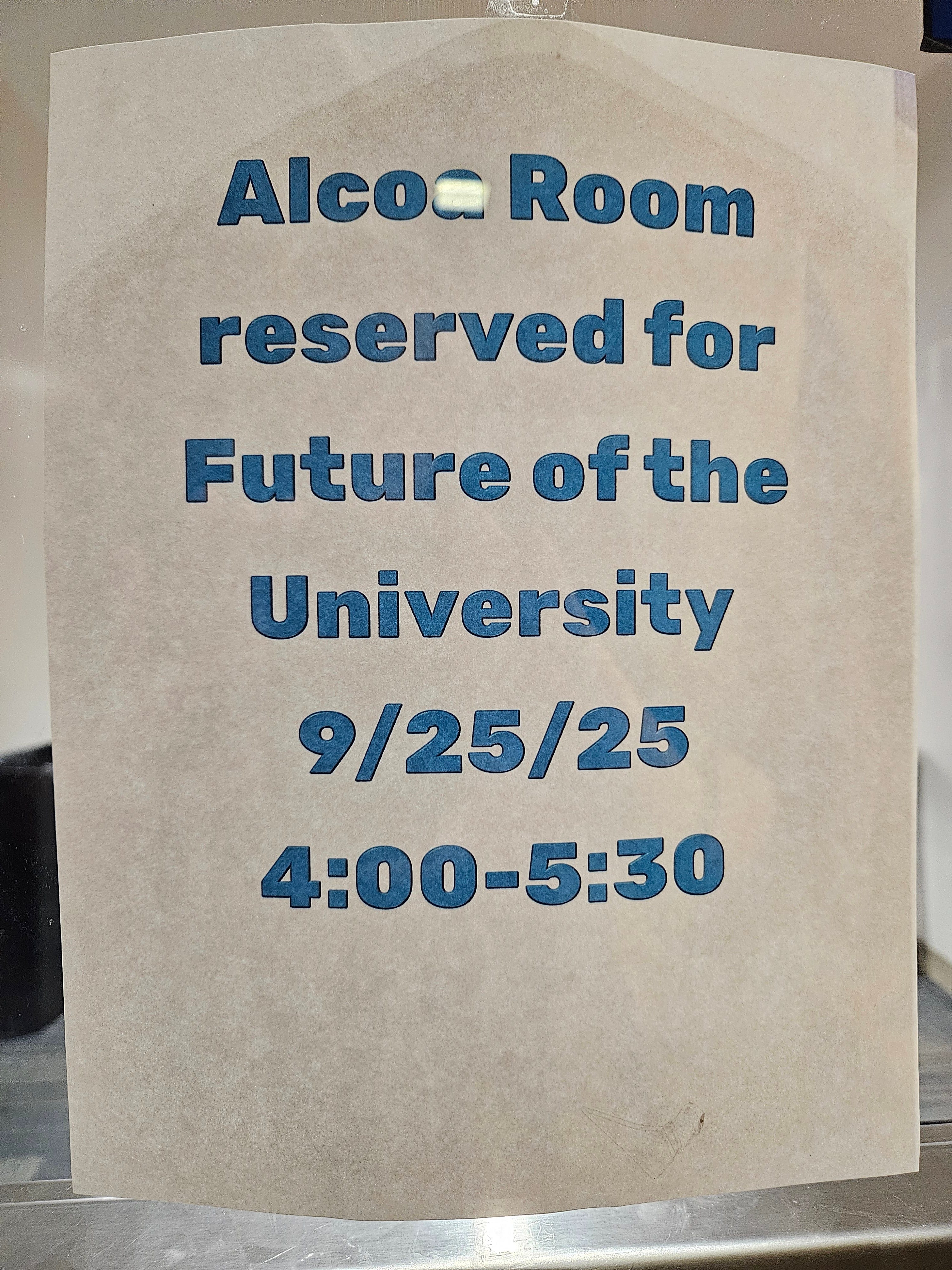
But I was not the only person to smile the other day when we arrived at our meeting room and found this sign taped to the door:
Onward.