

On Stories and Institutions
First published: December 15, 2025. Posted here for archival purposes.
“Everything in Between” is about the systems, institutions, and practices that people build, “things” of a sort that sit in between us, between groups of us, between “us” and “them,” and between us and other systems and institutions that seem terribly far away: “the market,” “the state,” the universe, and so on.
In addition to my posts here, I co-host a podcast titled “Your Leadership Podcast,” which is available on Spotify and wherever fine podcasts are available. I write about law and legal education at TaxProf Blog and for several years co-hosted a podcast about technology and law titled “Your Future Law Podcast.“ My older blog about Pittsburgh and renewing cities, Pittsblog, is still available online, as is my original blog about law, technology, and governance.
“Institutions,” to me and many others, are more than formal organizations; they are patterns of practices. They are collections of behaviors and associated ways of thinking and deciding through which groups of people organize themselves, live their lives, and interact with other groups. Institutions have members, leaders, and rules for who is “in” and who is “out” and “who” does “what” and “what happens when people disagree” – rules that are sometimes explicit and sometimes tacit. Institutions grow and change, often incrementally and occasionally dramatically. Institutions have histories, contexts, and values. Sometimes it is possible for a group of people to design an institution, with planning and purpose. Sometimes “institutions happen,” over time. Institutions overlap with other institutions in complicated ways. Lots of different research disciplines study institutions, economics perhaps most prominently but far from exclusively.
Because understanding institutions is critical to understanding, well, pretty much everything, I am always looking out for a great case study of an institution – sometimes an institution in formation, sometimes an institution changing, sometimes an institution fading or failing. Sometimes that means an institution that has been (nearly) forgotten. Institutional memory means not only what an institution remembers about itself but also what we remember about institutions, and how.
So:
I’ve been writing here for a while about “the university” as an institution, partly because working in a university is the professional life that I lead and one that I know particularly well and partly because I’ve been staring at the university for almost 20 years as a case study of knowledge commons – a genre of institutional governance. Today I shift gears a bit, at least briefly, to return to an institution that I also know pretty well, again (partly) because it falls within my knowledge commons “lens”: the city. And, specifically, to Pittsburgh, where I live.
I’ve been writing about Pittsburgh on and off for more than 20 years, sometimes via social media; sometimes in academic pieces. I took an interest in Pittsburgh-as-place initially because I am not a Pittsburgher. I did not grow up here. (Obsessive about such things as some Pittsburghers are, technically I do not live in the city of Pittsburgh proper. I am a suburbanite – as are the overwhelming majority of the residents of the Western Pennsylvania region that is typically referred to, collectively, as “Pittsburgh” and that was, once upon a time, labelled the “Pittsburgh District.”) I was raised in and spent a decent part of my pre-academic career what is now Silicon Valley, a place that is many things that Pittsburgh is not, including impressively dismissive of history, culture, and context. It’s the contrast that fascinates me, a place that cannot escape its past and a place almost literally does not care about its past.
During my time in Pittsburgh, I have learned so much about its history, culture, and context that I know a lot of things that natives don’t. I know where Isaly’s used to be, for example, the joke being that Pittsburgh’s roads are difficult to navigate, and insiders once gave directions by saying, “turn left where Isaly’s used to be.” I once had the hubris to build on my blend of acquired and imported knowledge to offer Pittsburgh’s leaders, investors, and entrepreneurs a road map to regional postindustrial prosperity.
All of which is a windup to this embarrassing admission – a giant gap in my institutionally-motivated appreciation of this city: Until recently, I did not know about the Freedom House Ambulance Service.
Which is, to lean into my theme, a fabulous story of institutional formation, fading, and now remembering.
Put simply and factually, the Freedom House Ambulance Service was a community-based paramedic service based in and operated out of Freedom House in the Hill District, Pittsburgh’s best-known historically Black community. It was a pioneer in operating an ambulance service staffed by paramedics trained to deliver emergency care, and it was staffed almost entirely by Black residents of the Hill District itself. The Freedom House Ambulance Service was launched in the late 1960s and survived into the mid-1970s, when the City of Pittsburgh and its police department (officially, the Pittsburgh “Bureau of Police”) finally and formally ended their resistance to a publicly-operated paramedic-staffed ambulance service.
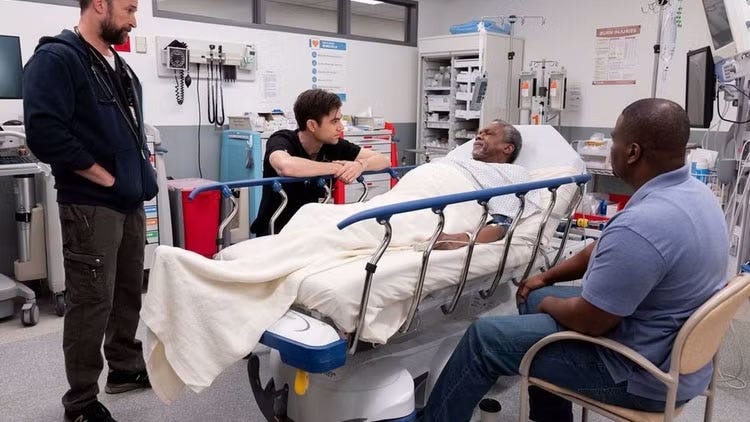
If you happened to watch season 1 of The Pitt, HBO’s medical drama set in Pittsburgh, among the pieces of local knowledge that the producers and writers dropped into the show was the fact that a patient in the ER – Willie, an older Black man – revealed to the staff that he had worked for Freedom House. Blink and you missed it.
I didn’t miss it, but I didn’t get it – all of my Pittsburgh learning had failed to reveal this bit of history – so I went down a rabbit hole, and among the many recent stories of Freedom House I came across and just read, almost in a single breath, “American Sirens: The Incredible Story of the Black Men Who Became America’s First Paramedics,” a 2023 book by Kevin Hazzard
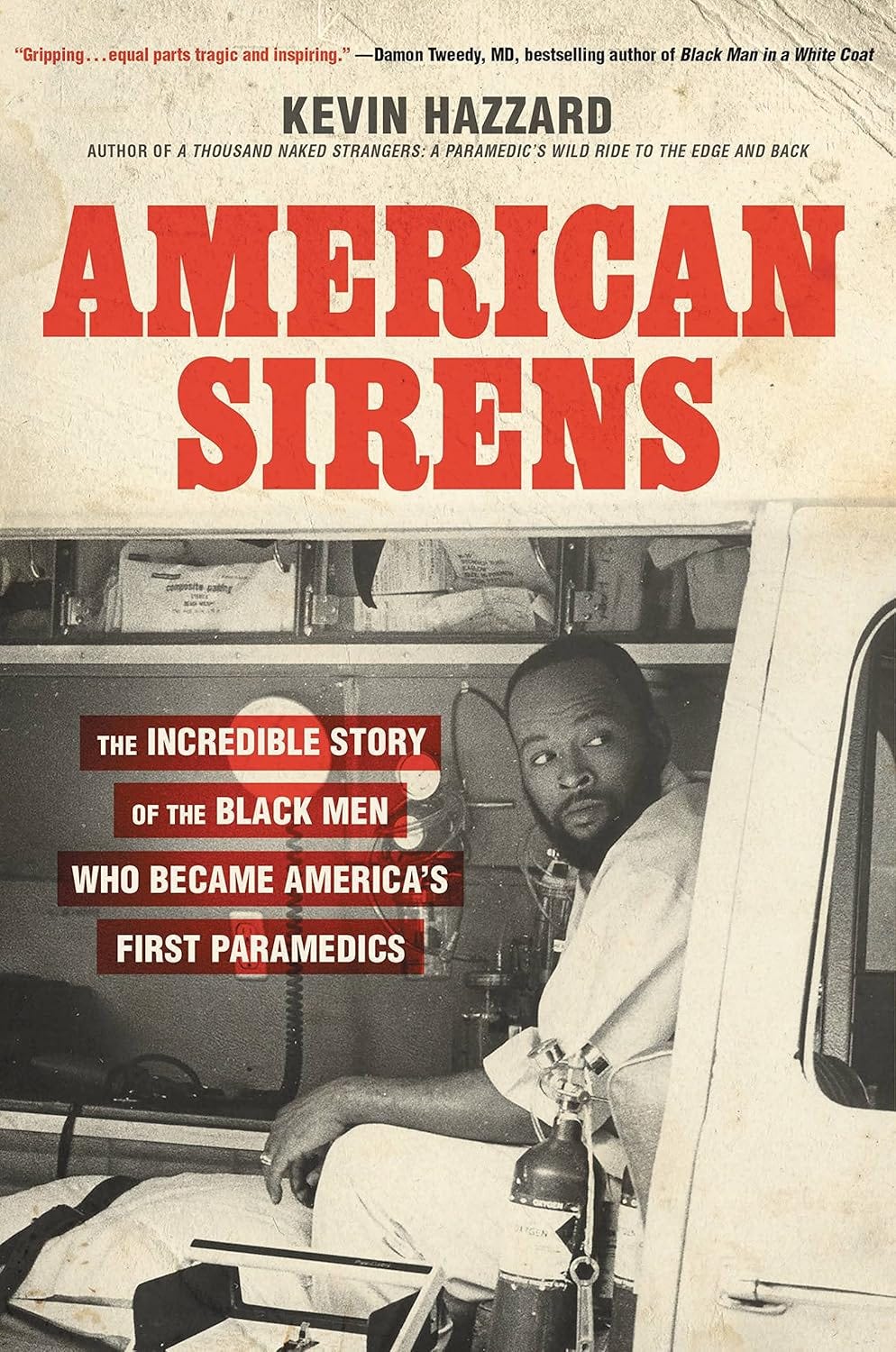
.
Mostly, I want to tell everyone with an interest in 20th century American history to read this book. Hazzard is a great writer, but he is also a former paramedic, so he is able to infuse his story of the Freedom House Ambulance Service with a propulsive humanity and attention to detail that is unusual even among the best works of narrative non-fiction. The book is, among many things, a powerful narrative of 20th century American history, told through a very place-specific and time-specific sequence of people doing great things, failing to do needed things, and encountering and overcoming resistance – only to discover even more, and worse.
But the book is more than that, too. The character portraits – real people, of course – are indelible. There is John Moon, the primary protagonist and early Freedom House paramedic, whose life offers the through-line for the whole book. There is Dr. Peter Safar, the University of Pittsburgh physician (and, with his wife, competitive waltzer extraordinaire) remembered for his contributions to developing modern CPR techniques but whose vision for a medically-trained ambulance corps synched up with the passion and purpose of James McCoy, a Pittsburgh civil rights activist who founded Freedom House Enterprises. There is Nancy Caroline, the physician who led the Freedom House Ambulance Service during its last years and, in the words of one obituary, who literally wrote the book on emergency medical service. And there are the paramedics themselves, many of whom make appearances by name.
I go through that brief summary in order to point out two things:
One: The Freedom House Ambulance Service was a story not only of heroic innovation and collaboration, building on the efforts of visionary, passionate people developing and deploying skills and leading to massive public benefits. It was (and is) also a case study of institutionalizing those individual contributions in a coordinated operation, with its instigators, sponsors, and leaders recognizing need, recruiting and training talent – both in the ambulances and in management and leadership, delivering benefit, achieving community acceptance (partly within the medical community and partly within the neighborhoods that the Freedom House Ambulance Service served), and realizing a degree of sustainability and continuity despite substantial financial and political headwinds. The story does not end altogether happily, as this exhibit at Pittsburgh’s Heinz History Center explains, but not all case studies of institutional innovation do. The Freedom House Ambulance Service has an important legacy, which is part of the reason for its mention in The Pitt. But much of that legacy lives on in the presence and practices of contemporary paramedics rather than in the service itself.
Two: To me, the story of the Freedom House Ambulance Service is just that – a story, and an important and powerful one. Institutions need more than money, time, and talent; they need stories, in order to survive and thrive, and they need storytellers, who are both great at their craft and persuasive to various audiences. Stories embed and share both value (“this is the good that the institution did”) and values (“this is why that was good”). Partly storytelling is the work of memory, ensuring that the people and their commitments are not lost; partly it is the work of teaching, hoping that what those people did might be done again, perhaps in a different setting. What might communities and groups take from the experiences of building and operating the Freedom House Ambulance Service and then put to their own use? Do those experiences generalize beyond the environment of the civil rights era? Beyond emergency medicine? Beyond the domain of what (today) is sometime referred to as “social” entrepreneurship?
Take this imaginative leap, for example:
AI in various forms is being introduced across all registers of education, rapidly and often uncritically. Who, where, when, and how are the resources akin to a “Freedom House Ambulance Service” being assembled to address avoidable harms and replicable benefits of AI in those contexts?
Like institutions themselves, stories sometimes can be crafted and shared in purposeful ways; sometimes stories emerge over time. Stories include people and places; stories exclude. The story of Pittsburgh today usually involves an uneasy blend of “the steel industry built Pittsburgh on the backs of hard-working blue-collar labor” and “modern Pittsburgh wants to be a world-leading center of AI and robotics research and development.” (That is Pittsburgh’s version of a typical postindustrial urbanist story: “we were great once, so we can carry that greatness forward in new ways.”) It’s obvious to many people that there are huge exclusions in that story, among them the pioneering collaboration represented by the men and women of the Freedom House Ambulance Service. Entering 2026, I may renew at least some of my history-seeking and commentary about Pittsburgh and postindustrial cities, with an eye on AI, robotics, and data but also with a new memory of what Pittsburgh once had, lost, and might recover.
What others have to say
Selections from new-ish commentary about the institutions of higher education and institutions of expertise, shared because these folks have me thinking, not necessarily because I agree.
FIFA recently held the draw for the upcoming “FIFA” World Cup finals next Summer, and the United States – qualifying for the finals automatically by virtue of serving as one of three tournament co-hosts – was drawn into a group that includes Paraguay, Australia, and a European team to be determined via a playoff: Kosovo, Romania, Slovakia or Türkiye.
(An aside: the weeks-long tournament commonly referred to as “the World Cup” and convening 48 countries (in 2026) is in fact the culmination of a World Cup tournament that has been going on for years and involves all 211 FIFA member nations and territories. The finals have been known as the “FIFA” World Cup only since 1974, when soccer’s global governor stepped firmly into the world of modern branding, with a partnership with adidas, as the tournament’s exclusive ball supplier, that continues to this day. Thus the quotation marks. To me and a huge number of soccer fans and players, the upcoming tournament is simply the World Cup.)
David Skilling, “Original Football,” distills the significance of the draw and the tournament in institutional terms:
The World Cup draw, the cringy spectacle that it was, isn’t just about picking the teams in each group. From a business perspective, it tells the global marketing industry how to plan and activated the commercial machine behind the biggest entertainment event on earth. In one afternoon, brands, agencies, broadcasters and host cities went from hypothetical thinking to actionable strategy.
The moment the groups are locked, creative direction, media spend, and on-the-ground activations all start getting shaped. National rivalries become messaging anchors to build campaigns around, while destinations become brand-theatre opportunities, and even the emotional arcs fans will carry into the tournament start to solidify, with marketing teams looking to see what threads they can pull on for their stories.
My bookshelf
Like a lot of academics, I read a lot. Like a lot of law professors, I read a lot about law and about governance. But I also read a lot of things just for fun and a lot of other things because you never know where interesting ideas might come from.
I promised a report on Ann Packer, “Some Bright Nowhere” (Harper Collins, 2025). But I jumped my own queue with “American Sirens.” More about Ann Packer’s work in a future newsletter.
Thanks for sticking with me.