

One Band From Many Sounds
First published: November 10, 2025. Posted here for archival purposes.
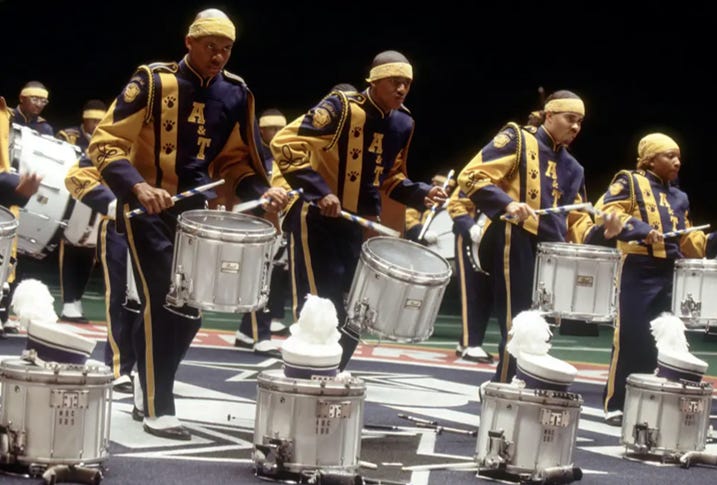
“Everything in Between” is about the systems, institutions, and practices that people build, “things” of a sort that sit in between us, between groups of us, between “us” and “them,” and between us and other systems and institutions that seem terribly far away: “the market,” “the state,” the universe, and so on.
My In-box and Send-box this week were occupied in part by a pair of contrasting essays.
On the one hand, a report published last Summer by the Boston Consulting Group (BCG), titled “US Higher Education’s Make-or-Break Moment.”
Its opening “Key Takeaways” section is representative of the authors’ commitment to a centralized, top-down, leadership-driven decision-making sensibility:
For higher education institutions, the question is no longer whether change is needed, but how fast can institutions make it happen.
- Colleges and universities are facing an existential crisis due to converging pressures from lower enrollments, federal cuts, the emergence of AI, and changing societal expectations.
- Fortunately, higher education leaders have an arsenal of powerful levers—technology, agile operational models, and valuable intellectual and brand assets—that can be activated for short-, medium-, and long-term gains.
- Institutions that accelerate investment in digital infrastructure, workforce-relevant programming, deeper industry partnerships, and scalable revenue streams can not only safeguard their financial sustainability but also build more resilient, future-ready organizations.
On the other hand (and to me, the more persuasive hand), an essay in the Chronicle of Higher Education by Ted Underwood, a faculty member at the University of Illinois, titled “AI Is the Future. Higher Ed Should Shape It; To stay at the forefront of knowledge production, we must fit technology to our needs.” A taste of this far more decentralized, bottom-up, faculty-led decision-making perspective:
LLMs are trained on a corpus of existing knowledge and can address solved problems without much help. But as AI runs up against the boundaries of existing knowledge, it will confront questions that are by definition not yet well formulated. What research problems matter most? Where can we find new data to address them? How should we evaluate progress?
AI will only become useful for these questions if it is shaped and guided by human researchers with experience of innovation. To be sure, if academic researchers are simply absorbed into industry-led projects, the benefits for education may be small. But if disciplines move proactively, they can dramatize their central role, and show that our campuses are not just lovely places to scribble in blue books but sites where students discover things that aren’t yet contained in any model. I don’t know whether disciplinary claims will be advanced most effectively by building discipline-specific models or by developing benchmarks that serve as the North Star for other builders. But I do feel confident that the strategic move is not to hope AI never learns to solve our problems, but to demonstrate that we are the ones who can teach it how. And then to invent new, more difficult problems to solve together.
In the context of college and university governance, one key challenge in reconciling the two, as always, is that leadership interest and authority are concentrated and faculty interest and authority are diffuse, leading to fundamental asymmetries with respect to how problems, solutions, and strategies are prioritized, funded, and implemented.
What others have to say
Selections from new-ish commentary about the institutions of higher education and institutions of expertise, shared because these folks have me thinking, not necessarily because I agree.
Rob Nelson at AI Log, “Language Machines as Antimeme: AI Log reviews Language Machines: Cultural AI and the End of Remainder Humanism”:
Until Dan Davies gets interviewed by Ezra Klein and Tyler Cowen, and cybernetics becomes the new hotness, I fear we are stuck with warmed-over sci-fi tropes as the framework for debating what we should do about large language models. This frame lets the participants imagine themselves in a high-stakes battle, understood by one side as heroic defenders of humanity vs. diabolical agents of the machine, and by the other as heroic makers of the future vs. diabolical Luddites standing in the doorway to paradise. We would do better with more comedy of the sort offered by Davies in The Unaccountability Machine and Stafford Beer with his back-of-napkin illustrations.
Thinking about LLMs means attending to their social and computational processes, not telling romantic tales or tragic stories. All the arguing over benchmarks and bubbles, and the prospect of the always-almost arrival of AGI, has led to a notable lack of curiosity about what generative, pre-trained transformers actually do with words. Engineers talk compute and parameters. The social critics talk next-token prediction machines and text-extruding stochastic parrots. But there is more going on than just “mathy maths.” There is a there there.
(Hello, sociotechnical systems. I enjoyed The Unaccountability Machine enormously.)
Hollis Robbins at Anecdotal Value, “Last Mile Education: The Syllabus Doesn’t Matter”:
If state lawmakers want to improve education, the first thing to recognize is that the revolution is here and that the only relationship that matters is between the faculty member and the student. Focusing on the syllabus is the wrong approach, if the concerns are what a student is getting from a course.
The right questions are:
- Does this professor possess knowledge that exceeds what AI provides? You can’t get this from a syllabus. You can only answer it by looking at the professor’s scholarship. This is the department’s job and a dean’s job.
- Does this professor know their students well enough to know that they are actually doing the work? You can’t get this from a syllabus or a transcript. You can only answer it by listening to students, looking at course evaluations, and implementing mentoring structures. This is a dean’s job.
- Does this course provide anything that students cannot access elsewhere? You can’t get this from a syllabus. Again, only department colleagues and a dean can answer this.
(She is building on her “AI and The Last Mile” post from almost exactly one year ago.)
My bookshelf
Like a lot of academics, I read a lot. Like a lot of law professors, I read a lot about law and about governance. But I also read a lot of things just for fun and a lot of other things because you never know where interesting ideas might come from.
The publisher’s site includes this abstract:
This book picks up where Karl Polanyi’s study of economic and political change left off. Building upon Polanyi’s conception of the double movement, Blyth analyzes the two periods of deep seated institutional change that characterized the twentieth century: the 1930s and the 1970s. Blyth views both sets of changes as part of the same dynamic. In the 1930s labor reacted against the exigencies of the market and demanded state action to mitigate the market’s effects by ‘embedding liberalism.’ In the 1970s, those who benefited least from such ‘embedding’ institutions, namely business, reacted against these constraints and sought to overturn that institutional order. Blyth demonstrates the critical role economic ideas played in making institutional change possible. Great Transformations rethinks the relationship between uncertainty, ideas, and interests, achieving profound new insights on how, and under what conditions, institutional change takes place.
I found the opening chapters, laying out the conceptual framework motivating the research, quite helpful. Blyth brings the history of ideas into conversation with Karl Polanyi’s analysis of 20th century political economy (arguing against the notion of self-regulating market capitalism and in favor of activist governments). The case studies, looking at changes to institutional environments in the US and in Sweden during the 1930s and 1970s, aren’t entirely successful, in the sense that the on-the-ground mechanisms that connect intellectual movements to material changes are not easy to specify, at least not consistently. But the book’s scope and ambition are more than sufficient to compensate for any perceived weaknesses.
Next on my list: Simon Garfield, “All the Knowledge in the World: The Extraordinary History of the Encyclopedia” (Harper Collins, 2022).
Thanks for sticking with me.