Skip to content

Bruce Boyden

Unsolved Mysteries of Copyright Law, 1963 Edition
unsolved mysteriesI recently stumbled across this interesting cluster of statements from the 1950s and early 1960s, which struck me as significant:

It is a curious fact that although the Copyright Law has remained without relevant change since 1909 this case should present a question both basic and novel. Does either the Copyright Act or the common law provide copyright owners with a remedy against non-manufacturing sellers of unauthorized phonograph recordings of copyrighted songs?

Shapiro, Bernstein & Co. v. Goody, 248 F.2d 260, 262 (2d Cir. 1957).

The question is whether an unpaid manufacturer of copyrighted goods, which are alleged to be defective by the copyright proprietor who has ordered them, may sell them in satisfaction of his claim for the contract price without infringing the “exclusive right” of the proprietor to “publish * * * and vend the copyrighted work,” 17 U.S.C. § 1(a); there is a related question as to the rights of persons who have already purchased some of the goods from the manufacturer. It seems exceedingly strange that these questions should arise for the first as is apparently the case, one hundred and seventy-three years after the initial grant of copyright protection by Congress, 1 Stat. 124 (1790), and two hundred and fifty-four after the Statute of Anne, 8 Anne, c. 19 (1709). Whether the lack of precedent is attributable to an unusually high standard of dealing, and of solvency, on the part of copyright proprietors and those manufacturing for them, or to an unaccustomed and unexpressed previous consensus in the profession as to the applicable rule of law, it is none the less remarkable.

Platt & Munk Co. v. Republic Graphics, Inc., 315 F.2d 847, 849 (2d Cir. 1963).

This action for copyright infringement presents us with a picture all too familiar in copyright litigation: a legal problem vexing in its difficulty, a dearth or squarely applicable precedents, a business setting so common that the dearth of precedents seems inexplicable, and an almost complete absence of guidance from the terms of the Copyright Act, 17 U.S.C. § 1 et seq.

Shapiro, Bernstein & Co. v. H. L. Green Co., 316 F.2d 304, 305 (2d Cir. 1963).

These are opinions by three different Second Circuit judges, in order, Hincks, Friendly, and Kaufman. They deal with separate issues, but they’re all related in a way — they all deal with the liabilities of ancillary parties to some sort of infringement. And in all three the judges express surprise that these questions haven’t been litigated to death, or resolved by statute, or both, already.

This surprise requires two conditions.

Read More »Unsolved Mysteries of Copyright Law, 1963 Edition

Speech by Proxy

Hal 9000 eyeOn Friday I mentioned Tim Wu’s op-ed last week, which asked if machines “have a constitutional right to free speech”? The question is posed in such a way that the obvious answer seems to be “no,” so it naturally drew responses which simply pose the question the other way: Timothy Lee at Ars Technica asks, “Do you lose free speech rights if you speak using a computer?”, and Julian Sanchez suggests that Wu’s argument would effectively remove First Amendment protection from any speech communicated via a machine. Paul Levy and Eugene Volokh similarly argue that while machines obviously don’t have speech rights, the people using the machines do, and Wu’s examples (e.g., Google’s search results) are the speech of the humans who designed the algorithm behind it.

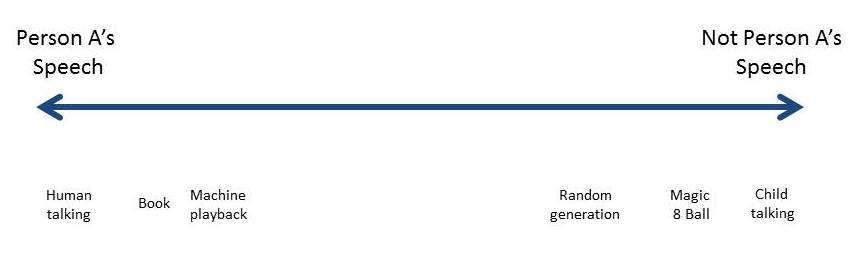
I think the distinctions here are trickier than any of these pieces, including Wu’s, let on. (Frank Pasquale appears to agree.) My own view, as suggested in my previous post, is that at least for copyright purposes, the more the machine contributes to the substance of the content, the less it is the speech of the humans behind it. But the distinction both First Amendment law and copyright impose is binary: something is either your speech or not your speech. Trying to figure out exactly where that transition occurs — even in principle — is difficult.

Let’s set up a spectrum of possibilities. So here’s the spectrum (click to enlarge):

Speech spectrum 1
Read More »Speech by Proxy

Do Video Games Dream of Electric Speech?

Half-Life 2Tim Wu had an interesting op-ed column in Wednesday’s New York Times: Free Speech for Computers? Wu’s op-ed is in part a response to a paper co-authored by Eugene Volokh, entitled “First Amendment Protection for Search Engine Search Results.” (See also Volokh’s response; criticism by Tim Lee and Julian Sanchez.) Volokh and his co-author, Donald Falk of Mayer Brown, argue that search results, for example those produced by Google (which commissioned the paper), should be treated as speech worthy of First Amendment protection. (Hail, Search King!) Wu argues that this argument threatens to “elevate our machines above ourselves” by “giv[ing] computers . . . rights intended for humans.” The purpose of the First Amendment, Wu writes, is “to protect actual humans against the evil of state censorship.” But computers don’t need that protection: “Socrates was a man who died for his views; computer programs are utilitarian instruments meant to serve us.” Wu concludes: “The line can be easily drawn: as a general rule, nonhuman or automated choices should not be granted the full protection of the First Amendment, and often should not be considered “speech” at all.”

This debate intrigues me, not so much for how it applies to Google (although that is interesting too), but for how it applies to video games.

Read More »Do Video Games Dream of Electric Speech?

Viacom v. YouTube: Not a Surprise

150px-YouTube_logoAs I mentioned below, the long-awaited Second Circuit decision in Viacom v. YouTube and its companion case, Football Association Premier League v. YouTube, was handed down today, with the Second Circuit reversing the district court opinion in part, affirming in part, and remanding for another round of summary judgement motions (yeehaw!) consistent with the opinion. Eric Goldman has some early analysis. Here’s my take, based on a single read, so I reserve the right to “revise and extend” my remarks.

I’ve got several points I want to make:

  1. The overall outcome is not a surprise, to me at least.
  2. On the issue of “What, beyond responding to individual takedown notices, do ISPs have to do to maintain their Section 512 immunity?” the answer is a) something — which is a win for plaintiffs — but b) not much, which is a win for defendants.
  3. The court I think identifies the correct role for “red flags” — at least, it was the one argued for in the amicus brief I drafted — but on the question of what constitutes “knowledge” I think the opinion is less successful. The distinction drawn between “specific vs. general” knowledge, both here and in connection with secondary liability generally, is I think not helpful and in any event will soon break down.
  4. The court helpfully ducks the massive red herring, subject of a considerable amount of argument in the briefs, blog commentary, and mentioned in the opinion below, over whether the fact that some allegedly infringing works may in fact be authorized should somehow bear on the interpretation of Section 512.
  5. It’s interesting and perhaps unsurprising that the court avoids legislative history and purpose as tools for interpreting the statute — with one significant (and I think salutary) exception.
  6. Just like the exclusionary rule sometimes warps Fourth Amendment criminal procedure law, there is reason here to be concerned that statutory damages might warp the substantive law governing the liability of ISPs.
  7. I have some higher-level thoughts on what the decision means for content owners and ISPs.

That’s a pretty long list, actually, so I’m going to have to break this up into multiple posts.

The Outcome Is Not a Surprise

The district court opinion essentially read portions out of the statute.

Read More »Viacom v. YouTube: Not a Surprise