Centers on Law and IP (Or: Perhaps We’ll Just Call It Flurm)
We have received a cease and desist letter demanding that we change the name of our IP center from “Center… Read More »Centers on Law and IP (Or: Perhaps We’ll Just Call It Flurm)
We have received a cease and desist letter demanding that we change the name of our IP center from “Center… Read More »Centers on Law and IP (Or: Perhaps We’ll Just Call It Flurm)
 The House Judiciary Committee held a markup hearing today on the Stop Online Piracy Act, H.R. 3261, the bill that is quickly shaping up to be this year’s big copyright battle. I’ve written two prior posts on the bill, Part I and Part II.
This is a good opportunity to recap where I came out at the end of my last post: SOPA in its then-current form was very troubling. The most troubling part was Section 103, which seemed to have been drafted with two inconsistent goals in mind, as if the co-authors were Dr. Jekyll working alongside Mr. Hyde: on the one hand Section 103 appeared to offer limited supplemental remedies in suits brought under existing copyright and trademark law, and on the other it appeared to significantly modify existing law by creating a free-form cause of action and a notice-and-takedown regime that went far beyond what the DMCA enacted thirteen years ago. For the reasons I stated in the post, I believe that the former reading — the Jekyll version if you will — had to be the correct one, because both the alleged new cause of action and the apparent notice-and-takedown regime were radically under-specified. I’m still concerned that critics of the bill are cementing an overly broad reading of it — the Hyde version — by not even acknowledging the Jekyll reading as a possibility. (This is akin to a concern that Jessica Litman has recently expressed as well, that copyright critics may ironically worsen the doctrines they are concerned about by asserting the most damaging interpretation.)
In addition to all that, SOPA as introduced had an overly broad scope for (what I argue are) the supplemental remedies — they appeared not just to apply to sites infringing in the U.S. but as a practical matter immune to traditional means of enforcement — the so-called foreign “rogue sites” — but to any website, anywhere, even one that a U.S. court would have no problem directly enforcing a preliminary injunction against with contempt sanctions. That is, even if Section 103 were amended to make clear, as I believe it should be, that the remedies involving domain names and ad networks are supplemental means of enforcement, it did not expressly limit itself to situations where there is a need for such extraordinary remedies. I would hope that courts would nevertheless apply such limits anyway, but that might be asking a lot from a court unfamiliar with the policy debates.
In advance of today’s hearing, SOPA’s main sponsor, Rep. Lamar Smith, offered a “manager’s amendment” to the bill making several changes. Does Smith’s amendment fix the above problems? Yes and no. Read More »Son of SOPA
I want to pick up on a topic nicely covered by Greg Lastowka — the recent case involving Bella’s jacket… Read More »When Easy Cases Make Bad Law
I feel like I’m scooping Jacqui here, since she’s the Madisonian Twilight expert, but I was so bothered by the recent district court decision in the Bella’s Jacket Brouhaha that I’m chiming in on the intersection of intellectual property and teen vampires.
Twilight is probably part of basic 21st century cultural literacy, so I’ll presume that, from Jacqui’s posts if from nowhere else, you’re aware of the basic contours of the very profitable films based on Stephanie Meyer’s very profitable books.
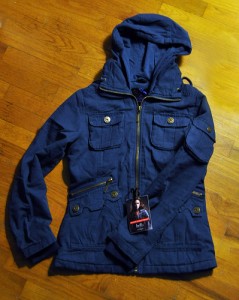
So see the jacket at right? (Image courtesy of SashaW, apparently a big fan of the films.) See that tiny hangtag on said jacket? The hangtag presents an image of Kristen Stewart, in the role of Bella, wearing the same jacket. Apparently, the jacket was originally made by BB Dakota and was formerly known as the “Leigh” jacket. Production of the jacket was discontinued prior to the making of the first Twilight film.
For some unknown (to me) reason, a costume designer in the employ of Summit Entertainment LLC (the studio responsible for the Twilight franchise) thought that Bella (Kristen Stewart) should wear the jacket in Twilight. Examples of such wearing from the film are here. And Summit used the image of Bella in her jacket as part of the promotional materials for the film, including the iconic Bella/Twilight shot, which is plastered all over the Internet.
So far so good, legally. Since fashion design is not protected by copyright law (at least at present!) and because consumers don’t think that every piece of clothing in a movie is a sponsored product placement (at least at present!), the makers of the Twilight film did not need to get a license from BB Dakota in order to use images of the jacket in the promotion of Twilight.
The Internet and “user-generated [amateur and homemade] content” have decimated much of professional porn, but the so-called “Golden Age of… Read More »A Gross and Revolting Sex Film